Reference
Historical texts, museum objects, and living traditions provide different kinds of evidence.
Early steppe & Scythian history
The Met chronology provides a regional framework for the emergence of mounted pastoral warfare. Specialist studies and archaeological collections help interpret Scythian riding and bow culture.
The Met — Central and North Asia, 1000 B.C.–1 A.D. ↗British Museum — Scythian society and material culture ↗Encyclopaedia Iranica — The Horse among the Scythians ↗Parthian warfare & the bow
Plutarch is an ancient literary source, written after the events at Carrhae. Chapters 24–25 describe how riders used missile fire and retreat, how armored cavalry fought, and how arrows were resupplied from camels. Such narratives are read alongside material evidence.
Plutarch — Life of Crassus, chapter 24 ↗Plutarch — Life of Crassus, chapter 25 ↗Encyclopaedia Iranica — Orodes II ↗The Mongol era
Museum essays and objects place mounted warriors within the history of the Mongol Empire and its artistic legacy. A later painting of a rider is evidence of representation, not a photograph of a thirteenth-century battle.
The Met — Riding across Central Asia ↗The Met — The Legacy of Genghis Khan ↗The Met — Two Mounted Warriors ↗Japanese yabusame
The Japan Equestrian Archery Association explains its ritual, historical transmission, and shooting forms. Japanese government cultural publications provide accounts of the Takeda and Ogasawara traditions.
Japan Equestrian Archery Association — On Yabusame ↗Government of Japan — Keeping an 800-Year-Old Tradition Alive ↗Government of Japan — Yabusame and Samurai Etiquette ↗Chinese mounted archery
King Wuling of Zhao & Hufu Qishe
The Shiji, volume 43, records the king’s arguments for changing clothing and adopting mounted archery. The reform is conventionally dated to 307 BCE. It documents adoption and military reform in Zhao, rather than the first invention of mounted archery.
Sima Qian — Shiji, The Hereditary House of Zhao ↗Kundulun District government — historical account and chronology ↗Three Forms illustrations
The three forms are described in the Ming-dynasty archery manual Shishu (射书) by Gu Yu. Line drawings of the three forms; source unverified.
Gu Yu — Shishu, digitized edition and bibliographical notice ↗Modern international sport
The competition overview uses the terms Korean style, tower, and hunt. The linked IHAA grading tables and scoresheets provide the scoring and grading references; the diagrams on Legacy reproduce 2011 layouts.
International Horseback Archery Alliance — Grading tables and scoresheets ↗IHAA world rankings — author’s competition record ↗Ritual and intangible cultural heritage
The national heritage register identifies Xibe archery in Qapqal, Xinjiang, as an extension project listed in 2021. It describes mounted and ritual forms within that specific tradition, alongside teaching and preservation programmes.
China Intangible Cultural Heritage — Traditional archery: Xibe archery ↗European mounted archery
The Hungarian National Museum documents Roman mounted-archer units in Pannonia. Ammianus Marcellinus, book 31, provides a late Roman description of Hunnic horsemanship and warfare; its hostile perspective requires interpretation.
Hungarian National Museum — Campona exhibition ↗Ammianus Marcellinus — Roman History, book 31 ↗British Museum — Introducing the Scythians ↗Indigenous horse cultures in the Americas
The Smithsonian’s A Song for the Horse Nation documents how Indigenous communities traded horses, used them in hunting and warfare, and understood their cultural meaning. The 2023 archaeological study adds evidence for horse care and use in parts of the Plains and northern Rockies during the early seventeenth century. The examples on this site focus on documented North American traditions.
National Museum of the American Indian — A Song for the Horse Nation ↗Horse trading among Native nations ↗Mounted hunting and Plains bows ↗University of Colorado Boulder — research on early horse dispersal ↗Yishi She: terminology & research
Yishi She (意识射) is a descriptive Chinese term for shooting by instinct rather than by conscious aim. The account given on this site is my own, based on my riding and on the sources below.
Gonzalez and colleagues’ 2017 study of expert and novice target archers provides related evidence about gaze control. It did not study mounted Yishi She, and the site does not claim that it validates a distinct neural mechanism.
Gonzalez et al. — Exploring the quiet eye in archery (2017) ↗Longhua News — an earlier use of 意识射 in Yunyi horseback archery (2021) ↗World Archery — a traditional archer’s account of instinctive shooting ↗Image credits
Ilkhanid horse archer. A Timurid drawing by Muhammad ibn Mahmudshah al-Khayyam, early 15th century, Iran. Staatsbibliothek zu Berlin, Diez A fol. 72, 5.13. Public-domain reproduction.
Drawing record & rights ↗Goguryeo hunting mural. Fifth-century historical artwork, artist unknown. Public-domain reproduction via Wikimedia Commons.
Mural record & rights ↗Parthian mounted archer. Photograph of a relief by Jona Lendering, 2019, via Livius. CC0.
Relief photograph & rights ↗Yabusame at Chiyoda Castle. From Chiyoda Castle (Album of Men), 1897, by Yōshū Chikanobu. The Metropolitan Museum of Art, JP3588. Public domain.
The Met collection record ↗Stirrup image
Pair of stirrups. Tibetan or Mongolian. The Metropolitan Museum of Art, Fletcher Fund, 2004; accession 2004.400a, b. Public-domain image.
Museum object record & rights ↗History illustrations
The steppe in Övörkhangai Province, Mongolia, in 2023.
Bernard Gagnon. CC0 1.0; Wikimedia thumbnail.
Image source ↗License ↗Horse herding in western Mongolia, 2022: a contemporary pastoral scene.
Bfreeproductions. CC BY-SA 4.0; Wikimedia thumbnail, no crop.
Image source ↗License ↗A modern statue of King Wuling of Zhao in Congtai Park.
Image by 我乃野云鹤, 2011. CC BY-SA 4.0; unchanged.
Image source ↗License ↗An Etruscan bronze depiction of a Scythian mounted archer, early fifth century BCE.
The Metropolitan Museum of Art, Gift of Norbert Schimmel Trust, 1989; 1989.281.78. Public domain.
Image source ↗License ↗Cavalrymen’s tombstone from Intercisa: evidence of Roman cavalry service in Pannonia.
Image by Szilas; Hungarian National Museum. Released into the public domain. This stone depicts cavalrymen, not a shooting scene.
Image source ↗Huns besieging Aquileia in the fourteenth-century Chronicon Pictum: a later medieval portrayal.
Anonymous medieval illuminator. Public-domain reproduction.
Image source ↗License ↗The Battle of Legnica (1241), depicted more than a century later in a 1353 manuscript.
Legend of Saint Hedwig, unknown illuminator. J. Paul Getty Museum collection. Public-domain reproduction.
Image source ↗License ↗Frederic Remington’s later depiction of Coronado’s expedition.
Frederic Remington. Public-domain reproduction. This later painting illustrates Spanish equestrian travel, not the first arrival of horses.
Image source ↗License ↗Comanche riders in George Catlin’s painting, 1834–1837.
George Catlin, Comanche War Party, Mounted on Wild Horses. Smithsonian American Art Museum. Public domain. An illustration of equestrian culture, not a record of a horse exchange.
Image source ↗License ↗Catlin’s depiction of Comanche hunters using lances and bows, 1846–1848.
George Catlin, Comanche Indians Chasing Buffalo with Lances and Bows. Public-domain reproduction.
Image source ↗License ↗The modern horseback-archery image was supplied by the author. Image credits identifies the Parthian relief and Goguryeo mural, followed by the Ilkhanid drawing and Chiyoda print.
Homepage card images
History: Mongol mounted archer. Chinese miniature, unknown artist. Public-domain reproduction.
Image record & rights ↗Warfare: Turkish traditional bow and arrows. The Metropolitan Museum of Art, Rogers Fund, 1935. Public-domain image.
Museum object record & rights ↗Legacy: Yabusame in Zushi. Photograph by Urashimataro, 2009. Released into the public domain by the photographer.
Image record & rights ↗Reference: mounted-archer manuscript illustration. Unknown artist. Public-domain reproduction via Wikimedia Commons.
Image record & rights ↗Technique: Fen Zong She. The supplied line drawing is also used in the Three Forms group; its image source remains unverified.
Horseback Archery Museum
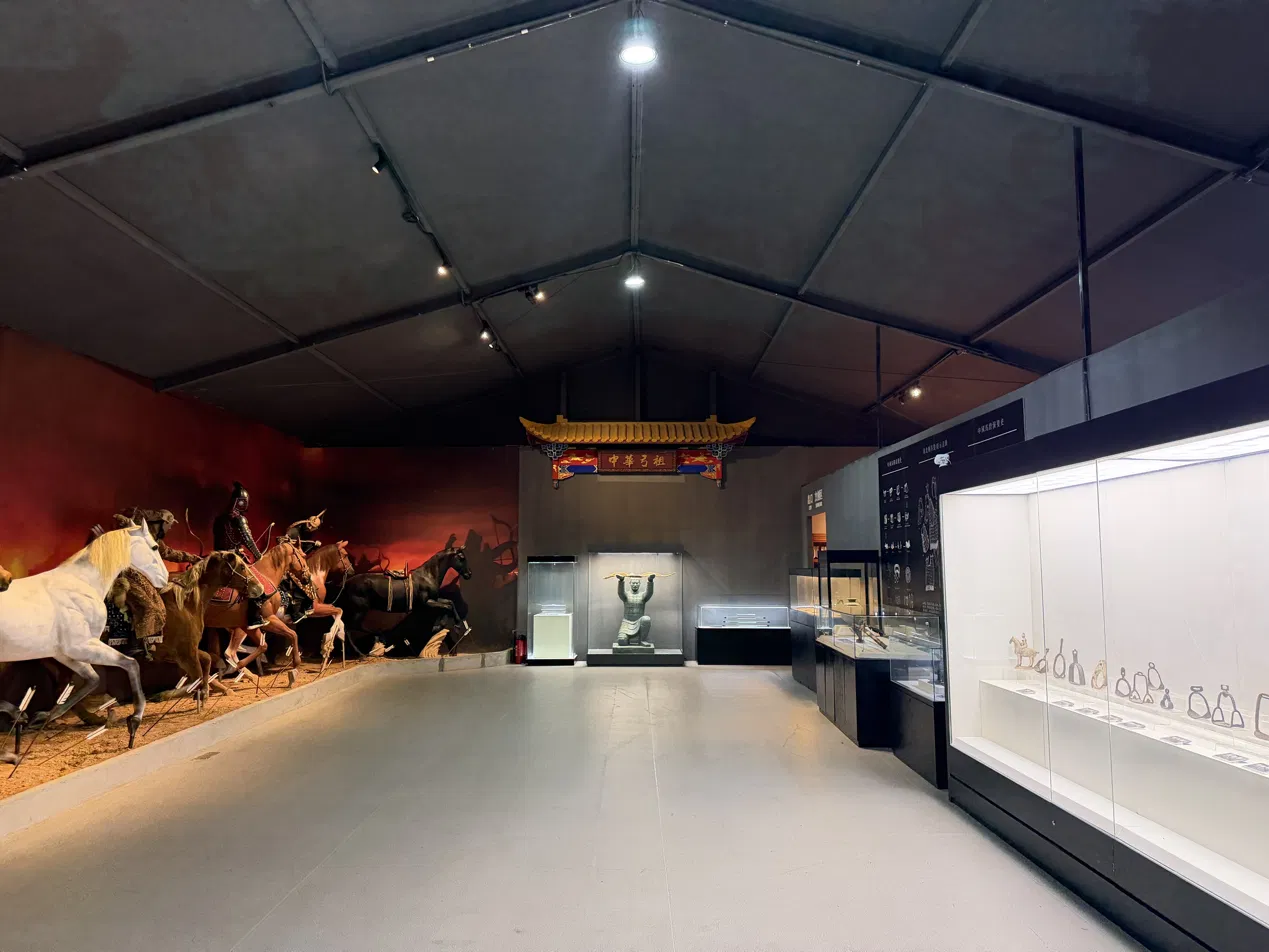
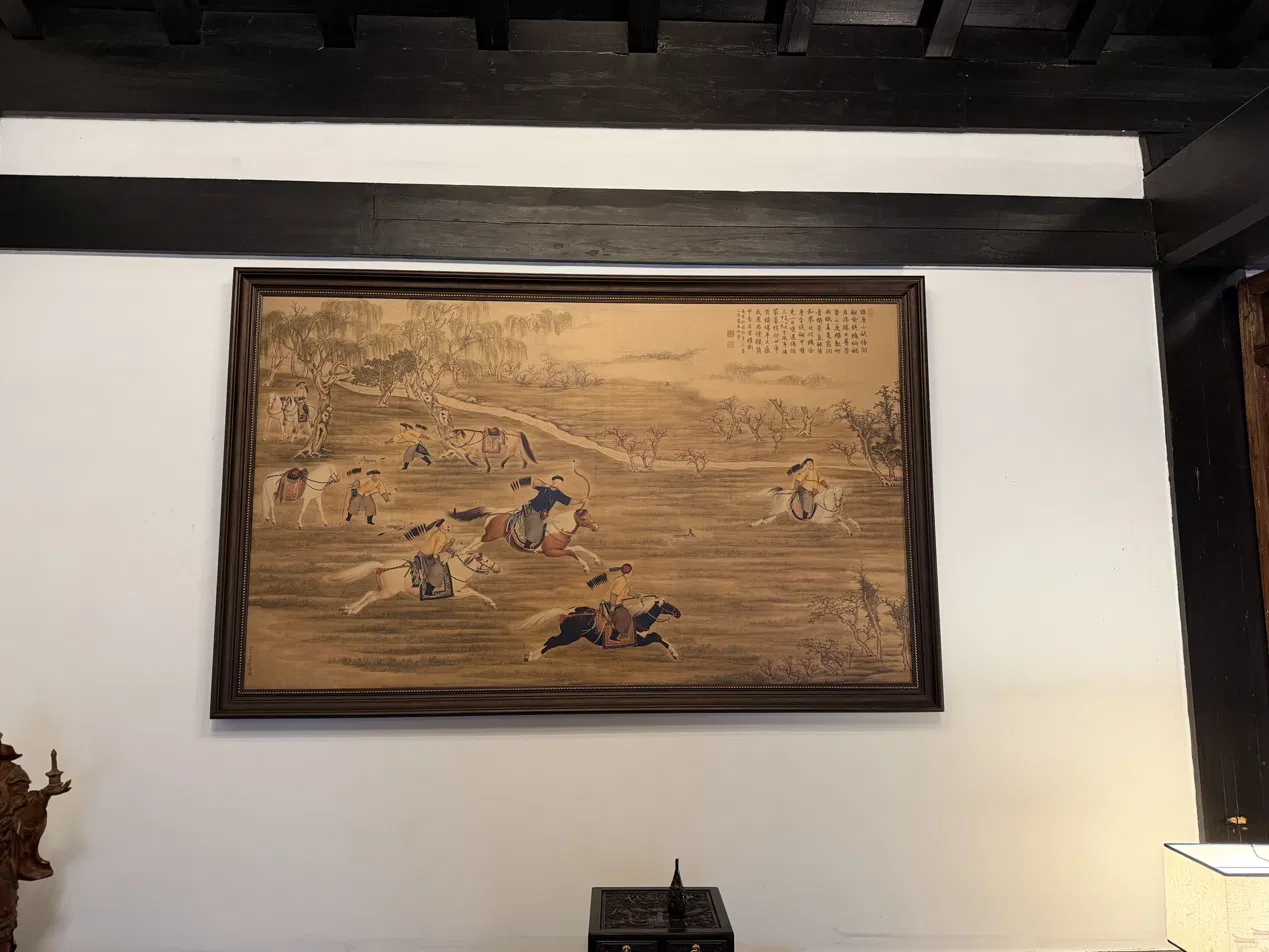
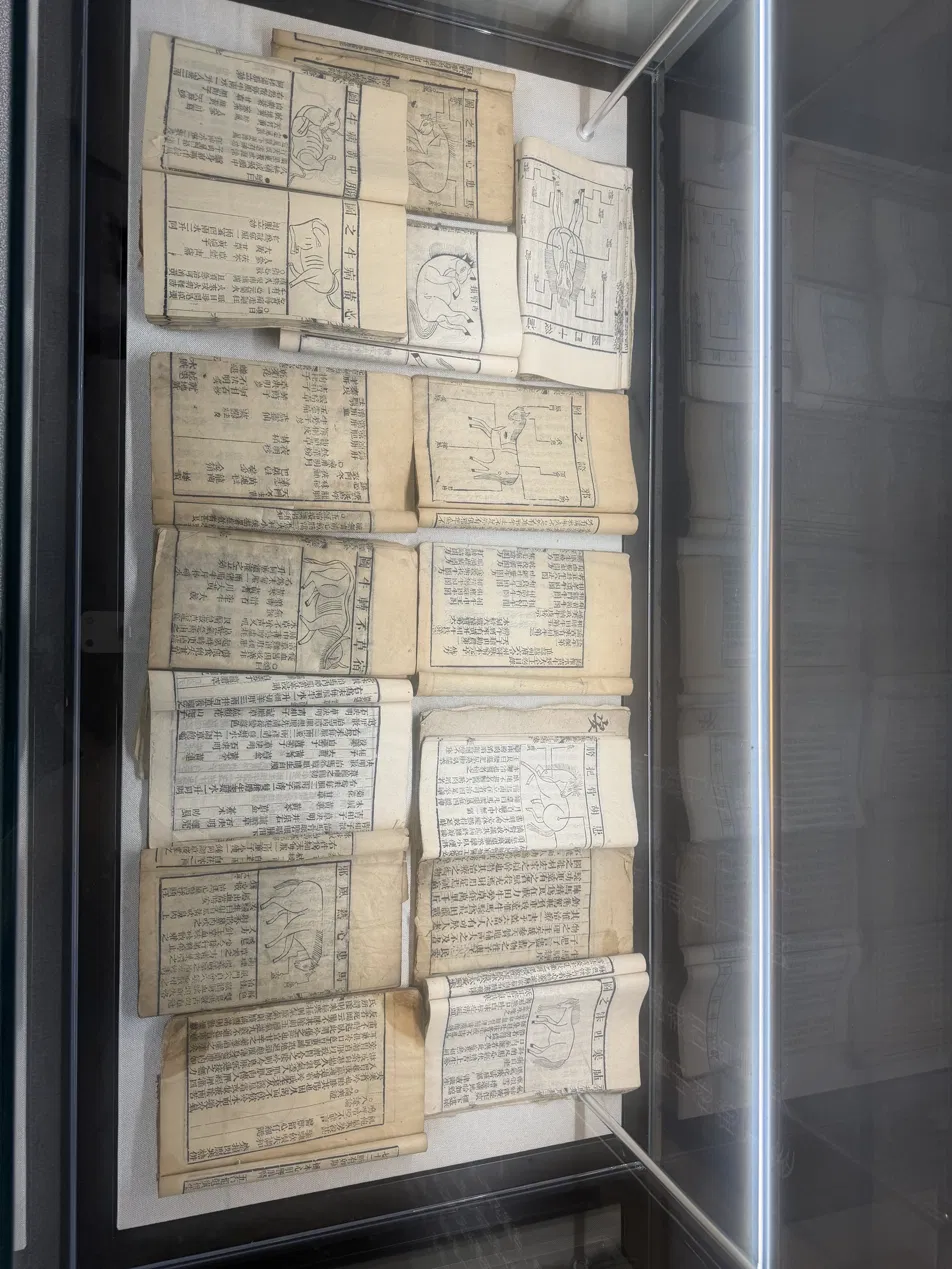
I took the museum photographs used throughout this archive. The displays include a plaque reading 中华弓祖 and a figure carrying a bow.
Photographs by the author.