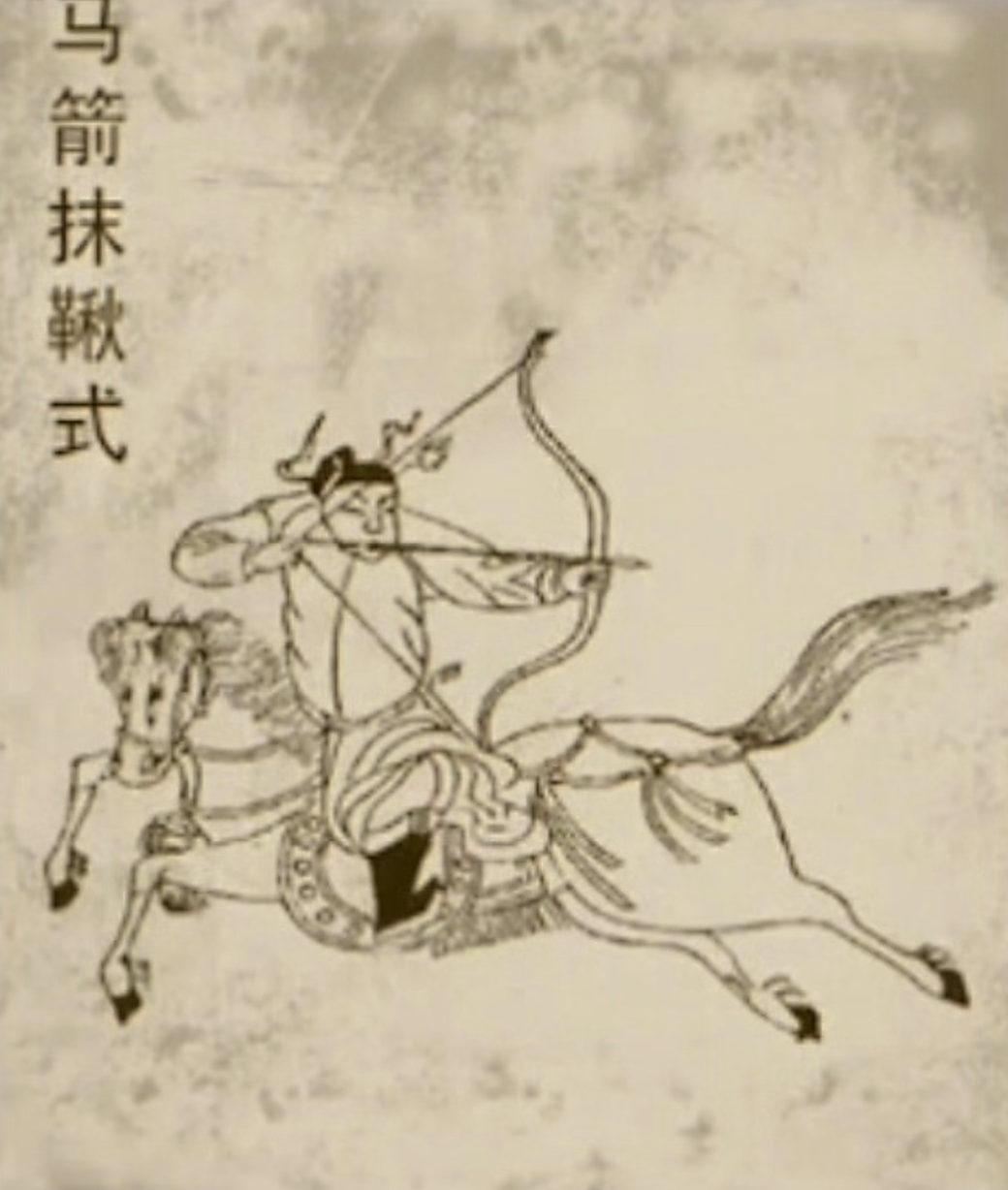
Begin with the Eurasian steppe, then follow mounted archery through Asia, Europe, and the Americas. Each region has its own history of adoption, adaptation, and cultural meaning.
Shared technology, local identities
Traditional bows, thumb-draw traditions, specialized saddles, quivers, and mounted hunting practices moved across wide networks. Yet no region simply copied another. Equipment and technique were repeatedly adapted to different environments, body mechanics, horses, and social systems.
Shared techniques took on different meanings as they moved between societies.
Where the story begins
The Eurasian steppe
The earliest well-documented histories of mounted archery center on the Eurasian steppe during the first millennium BCE. This connected grassland corridor reaches from Mongolia and southern Siberia through Central Asia to the lands north of the Black Sea.
Its emergence was a regional process: riding, bow-making, mobile pastoral life, and military practice developed together. The evidence does not identify one universally agreed inventor, city, or modern country as its single birthplace. Different societies later adopted mounted archery and gave it distinct forms.
Central and Inner Asia, northern China, the Mongolian plateau, Iran, Korea, and Japan.
First millennium BCE · Central & Inner Asia
A mobile way of life
Across the steppe, horses increased the distances people could travel, herd, hunt, and fight. Mounted archery joined this mobility to a weapon that could be used before an opponent reached close quarters.
Short traditional bows were important in many of these traditions. Their materials and shapes varied, and the history of mounted archery developed through contact between neighboring communities.
307 BCE · Zhao, northern China
King Wuling of Zhao: Hufu Qishe
During China’s Warring States period, King Wuling of Zhao promoted Hufu Qishe: adopting the clothing of northern horse-riding peoples and training in mounted archery. The reform is conventionally dated to 307 BCE.
The Shiji, in its account of the Zhao ruling house, describes the king arguing for this change despite opposition at court. Zhao’s northern and frontier neighbors helped shape the military problem he sought to solve.
The reform linked clothing suited to riding with changes in military training. It is a major episode in the adoption of mounted archery by a Chinese state, drawing on skills already practiced among neighboring peoples.
53 BCE · Iranian world & Mesopotamia
Parthian horse archers
Parthian armies brought light mounted archers together with heavily armored cavalry. At Carrhae in 53 BCE, mounted missile fire helped defeat the Roman army led by Crassus.
Plutarch describes replacement arrows being supplied from camels. The famous backward-facing “Parthian shot” also expresses a central tactical possibility: a rider could remain dangerous while moving away.
13th century · Mongolian plateau and across Eurasia
Mongolia and the Mongol Empire
The Mongolian plateau was home to pastoral societies in which horsemanship and archery were closely connected. In the thirteenth century, the armies of Chinggis Khan and his successors brought these skills into campaigns across much of Eurasia.
Mounted archers operated within organized forces supported by remount horses, scouting, communication, and coordinated movement. The horse gave the archer mobility; organization allowed many riders to act together.
The Mongol story belongs at the center of a global history of horse archery. Campaigns and political connections reached into China, Central Asia, Iran, and eastern Europe, while regional traditions continued to develop in different ways.
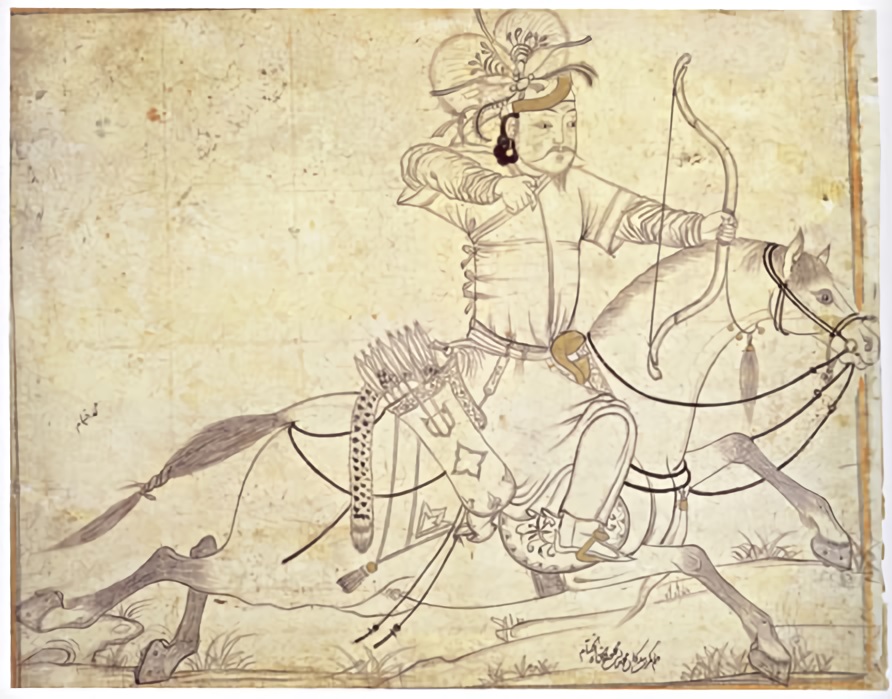
A later Timurid drawing of an Ilkhanid horse archer, early 15th century. The artwork looks back to the Mongol world.
5th century · Northeast Asia
Goguryeo: archery in the hunt
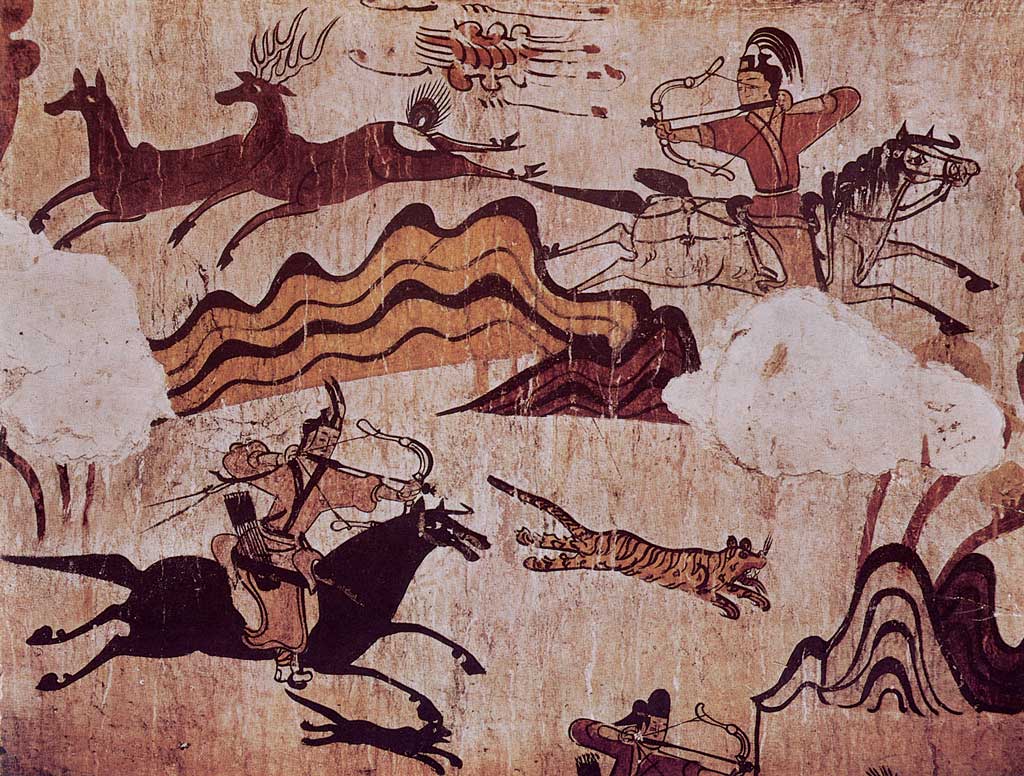
Goguryeo tomb murals depict archers pursuing animals on horseback. These images preserve evidence of mounted hunting, clothing, equipment, and body position in Northeast Asia.
The Korean example also shows why the history extends beyond warfare: the horse and bow belonged to hunting and elite culture as well.
Japan developed its own forms of mounted archery using the long, asymmetrical yumi. Yabusame became closely associated with warrior culture, formal etiquette, and shrine ritual.
The Takeda and Ogasawara traditions preserve historical teachings. In a typical yabusame performance, the rider shoots at successive targets to the left while galloping. The ritual carries meanings that extend beyond a sporting score.
The tradition experienced periods of decline and renewal, including a revival supported by Tokugawa Yoshimune in the Edo period.
The Black Sea region, Roman frontiers, the Danube, and the connections between Europe and Asia.
First millennium BCE · North of the Black Sea
Scythian mounted archers
Scythian communities occupied parts of the western Eurasian steppe, including areas north of the Black Sea. Horses, bows, and mobile pastoral life were closely connected in their material culture.
Scythian mounted archery is an early and important part of European history. The steppe crosses today’s continental boundaries, so Asian and European developments cannot be treated as entirely separate origin stories.
Roman period · Pannonia and the Danube
Mounted archery in the Roman army
Mounted archery was also incorporated into armies based outside the steppe. The Hungarian National Museum’s account of Campona notes that the Roman army included mounted archer units, many stationed in the Pannonian provinces.
These units show the movement of military skills and personnel into the Roman frontier system. European mounted archery was shaped by both mobile steppe societies and the states that encountered and recruited mounted archers.
Late 4th–5th centuries CE · Eastern and Central Europe
Hunnic mobility
Hunnic groups entered the European historical record during the late fourth century and became major actors in the lands near the Black Sea and Danube. Mounted warfare and missile weapons were prominent in Roman descriptions of them.
Ammianus Marcellinus describes their horsemanship and rapid attacks. His account is an outside, often hostile Roman perspective; it is evidence of how they were described, rather than a neutral portrait of Hunnic life.
13th century onward · Eurasian connections
Mongol expansion and later traditions
The Mongol expansion carried mounted armies into eastern Europe as part of campaigns that connected regions across Eurasia. This was a later chapter in a much older history of contact across the steppe.
Mounted archery remained part of the region’s military history as different armies adapted their equipment and tactics. Modern sporting and heritage communities draw on these histories in new settings.
Spanish arrival, Indigenous exchange networks, and the horse nations of the North American Plains.
From the late 15th century · Caribbean and mainland Americas
The return of domestic horses
The history of mounted archery in the Americas follows a different chronology from Eurasia. Domestic horses returned with Europeans, beginning in the Caribbean in the late fifteenth century and spreading onto the mainland during the colonial period.
Indigenous communities acquired, raised, exchanged, and integrated horses into their own societies. Their agency and knowledge were central to the growth of American horse cultures.
17th century · Southwest, Plains & Rocky Mountains
Indigenous networks spread the horse
Horses moved through Native exchange networks that connected Pueblo, Navajo, Ute, Apache, Comanche, Shoshone, and other communities. Different nations adapted riding to their own lands and needs.
Archaeological research published in 2023 found evidence for Indigenous care and use of horses in parts of the Great Plains and northern Rocky Mountains by the first half of the seventeenth century—earlier than some European written accounts had suggested.
18th–19th centuries · North American Great Plains
Mounted bow hunting and warfare
On the Great Plains, horses transformed bison hunting, transport, and warfare. Bows remained important within these changing ways of life, and mounted bow hunting became one of the most recognizable forms of American horse archery.
Comanche, Lakota, Cheyenne, and other nations developed distinct equestrian cultures. Their traditions should be understood in their own historical settings, including kinship, trade, land, and spiritual relationships with horses.
Today · Across the Americas
Living heritage and modern sport
The Americas now include both living Indigenous equestrian traditions and modern mounted-archery communities. These experiences share a relationship between horse, rider, and bow, while their histories and purposes vary.
International sporting formats have created new ways for riders to meet and compete. Historical heritage and contemporary sport remain connected parts of the story, rather than one uniform tradition.
The early American horse-archery examples documented here focus on North America. South American equestrian traditions have their own histories and equipment; horse riding alone is not evidence that every community practiced mounted archery.